

Based Neo-Jeffersonianism
Jefferson at 250: between the life of the mind and the work of the hands, from Monticello to the homestead tsunami: Postman, Wendell Berry, Joel Salatin, Alasdair MacIntyre, and Susan Wise Bauer

It’s America’s birthday this week — and it’s not any old birthday, it’s the big 250th. So what follows is a big 250th birthday present from me to America.
I figured there’s going to be a bunch of over the top anti-patriotism in this little niche of the world we call “theory,” so I’m doing something different. I’m going to offer something of an apology in the classical sense, but the real thrust of this piece is a vision for the future that does not renounce the urban and developed world, but which insists that what I’m calling Based Neo-Jeffersonianism provides a kind of ground humanity needs if it is not to lose its footing as we move into the cyborg era.
The anti-founder sentiments are common fare these days — we could even say it has become something of a cliche. Last year, while on a trip out to Polyface Farm in Virginia, I took my wife and mother both to Monticello for a tour of Jefferson’s estate and, even there, the whole tour of his epic grounds revolved around the fact that he did, in fact, own slaves. Who knew? I think at this point, we all knew. In fact, that might be all we know.
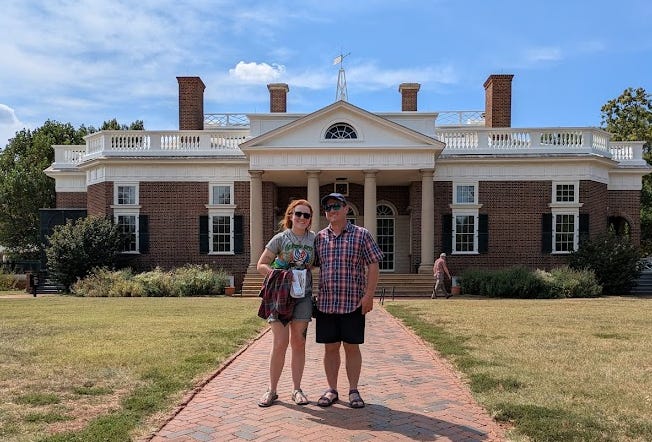
Expunged from memory are the real reasons that it matters, the significance of which gets lost on people, both in terms of his actual ideas and the context in which they intervened. Worse still, all of this functions to cover over and naturalize our own material conditions that sit atop and sustain relations of production that are certainly less than free — for reasons that would not have been lost on Jefferson or a citizenry with a basis in the kind of education he hoped we would have all gained by now.
Hope you enjoy.
I. The Vision
The Jeffersonian vision is best understood as a dream about staying free. Freedom for Jefferson had a material precondition: a man who grows his own bread cannot be bought. That single conviction organizes everything else, including the relationship between work and education.
In Query XIX of Notes on the State of Virginia, Jefferson writes that “those who labour in the earth are the chosen people of God, if ever he had a chosen people, whose breasts he has made his peculiar deposit for substantial and genuine virtue.”1 His logic goes like this: the farmer who owns his land and feeds his family looks to his own soil and industry for his needs, while the artisan and the wage-laborer depend on the casualties and caprice of the customers. Jefferson argues that this market dependence begets subservience and venality, suffocating the germ of virtue while preparing fit tools for the designs of ambition. In other words, he saw the mass proletarianization that was happening in England and he knew it was a radical departure from the shire-like existence of their past, so he hoped to lay the ground for a new mode-of-life that could make for a freer people not enslaved to the market, state, or even ambition itself. Against industrialization, he said to let the workshops (which were well on their way to becoming factories) remain in Europe. He compared the urban population to sores on an otherwise healthy body. He considered the yeoman the citizen par excellence, due to his economic independence, which makes political independence real rather than nominal. No polity can have a self-governing people made of dependents. That’s a basic contradiction in terms.
We address the more obvious contradiction at the heart (or plantation) of Jefferson’s work below. For now, I want to really just emphasize that this basic vision that gets called “Jeffersonian” is one that people rarely have more than a gloss on. He is well aware that ignorant farmers are not freer than literate urbanites.
Jefferson is where work and education meet, because he insists that self-government is not automatic. An independent farmer who cannot read the laws, recognize a demagogue, or follow an argument is independent in his stomach but a serf in his judgment. So Jefferson paired the agrarian base with an educational architecture, most fully in his 1779 Bill for the More General Diffusion of Knowledge, where he proposed dividing the counties into small districts, which he called “wards.”
Each ward would have a free elementary school open to every free child, taught largely through history so that citizens would learn to recognize tyranny. Above that, grammar schools, into which the best geniuses would be raked from the rubbish annually. Thus the talented sons of the poor could advance at public expense.2 Above that, the university would exist for the rarest of talent. The system was simultaneously democratic at the base and meritocratic above it: universal literacy for the mass who must choose their governors well, deeper cultivation for the natural leaders who must govern.
That phrase “natural leaders” points to the half of the vision many people forget. In the great October 1813 letter to John Adams, Jefferson distinguishes the natural aristocracy grounded in virtue and talents from the artificial aristocracy founded on wealth and birth, without either virtue or talents.
Jefferson calls the natural aristocracy the most precious gift of nature for the government of society. The whole problem of constitutional design, as he frames it to Adams, is to build a sieve that elevates the natural aristoi and excludes the artificial ones.3 So perhaps a little like Plato’s Republic, education would function as that sieve. Obviously this is somewhat true today, except that it’s a sieve that squashes talent and virtue while elevating the very kinds of people Jefferson was trying to weed out. Now education serves as a point of (brain drain) extraction for global capital into a pipeline that de-worlds intellectuals, removing them from their place of birth and assigning them citizenship in the rebel priest class, serving as administrators or shocktroops for capital’s technopoly.
The Jeffersonian dream is therefore not egalitarian in the leveling sense. It is a dream of removing the artificial barriers, inherited rank and inherited poverty alike, so that talent distributed by nature across all classes can find its level. The ward school exists to find the genius in the rubbish and the university is where he gets formed.
The wards do double duty in Jefferson’s vision. In his later letters, especially the 1816 letter to Samuel Kercheval, Jefferson develops the ward not just as a school district but as the smallest cell of self-rule, a little republic in which every man participates directly in the business closest to him, with a gradation upward through county, state, and federal.4 He took the New England township as his model. The same unit that educates the child governs the adult. Education and self-government are not two programs that happen to coexist. They are the same activity at two ages, learned in the same place. This is what he meant when he told Charles Yancey in 1816 that if a nation expects to be ignorant and free, in a state of civilization, it expects what never was and never will be.5 Freedom is a competence, and competence has to be cultivated. I suspect there is little doubt in the mind of anyone reading this that the competence for freedom has long since been lost, if ever it was obtained in the U.S.
You can see how much weight he put on all this in writing his own epitaph, which omits the presidency entirely. Among his greatest accomplishments he lists: author of the Declaration, author of the Virginia Statute for Religious Freedom, and father of the University of Virginia.6 Jefferson wanted to be remembered for what equipped a free people, and the university was the capstone. He designed it as an academic village, faculty and students living together around a lawn with the library, not a chapel, at the head — a deliberate architectural argument about what stands at the center of a free man’s learning.
But, but what about the slavery!?
Now the contradiction. Jefferson’s own integration of the life of the mind with the work of the hands was a fiction at the level of his own form-of-life. Monticello was a slave plantation. The leisure that produced the Notes, the letters, the architecture, the university, was extracted from the labor of roughly six hundred enslaved people over his lifetime.
For Jefferson personally, the balance of work and education was never struck inside one life. It was a division of labor across a hierarchy of bondage: the enslaved did the work, the master did the thinking, and the rhetoric of the independent free yeoman papered over the fact that the philosopher-farmer’s freedom rested on others’ unfreedom. He knew it was a moral catastrophe, and said as much. In the minds of most enlightened Americans today the dream of independence through one’s own labor and the reality of a plantation are considered irreconcilable. I’m going to do more than go out on a limb here and insist that this can, and should, be reconciled.
II. And So What?
People act like Jefferson’s slaveholding is a devastating contradiction, the kind that voids everything he wrote. I don’t think it is much of a contradiction at all. Or rather, it is exactly as much of one as my own life is.
I am writing this on a smartphone. The phone was assembled out of materials pulled from the ground by people afforded none of the privileges that help give intellectuals a hand out of the mud. They toil on the far side of an ocean, separated by hundreds of thousands of miles and at least six figures from those who needed to attend college to design and develop the devices for which their precious minerals are extracted.
The college-educated engineer in one hemisphere, the cobalt miner in the Congo in the other. And I’m over here, on a luxurious regenerative “certified organic” farm in the pristine evergreen pine forest air of North Idaho. I dictate my drafts into this phone while I am doing the most noble work possible. I have machines read PDFs aloud to me while I tie up tomatoes. I have machines transcribe my voice and help me clean up the transcripts while I do the chicken chores every morning and night. The piece you are reading (or listening to) sits on top of a division of labor I did not design and cannot personally undo, and it is precisely that division of labor that runs straight through the products of my intellectual labor.
So when someone tells me Jefferson was a hypocrite, I want to know by what standard. The only standard on offer is an abstract one, a picture of the good in which free people govern themselves, in mutual interdependence, working alongside one another in a free society. That is the standard he fails to live up to. Notice whose standard it is. It is his. Jefferson is the one who raised it to its ideal limit. You cannot call him bad by that measure without first granting that he is the one who gave it to us. Set against the men of his own century, and frankly against most of ours, his picture of the good stands above the rest.
So he painted a picture he was not himself in, but again, nobody was. That is the point. Yes, he had slaves. So what, exactly, do we imagine separates us from him? We have the privilege of distance living in a world on the other side of wars we will never have to fight. And yet we live inside a division of labor whose ruthlessness gets white-washed by the storytellers who frame the past as evil and the present as enlightened. The children of coal miners in the U.S., Belizean sugar cane farmers, and Congolese cobalt miners do not have anything close to the access to education that Jefferson was trying to build for the children of dirt farmers in Virginia. We did not abolish the problem. We just exported it.
The slaves were freed, we say, as if that settles the account. What actually happened to most of them is that they were freed into the market, which is a freedom in name only — for the very reasons already given by Jefferson. The freedom to be exposed to market forces with nothing to fall back on has, in at least more than a few cases, left people worse off. None of this makes slavery anything other than evil. The point is that it makes our modern self-congratulation ridiculous. We are not standing on a mountain looking down at Jefferson. We are standing in a different part of the same valley while supposing we’ve left.
Jefferson’s slaveholding does not undermine what he wrote. If anything it tells you what kind of writing it was. He was not describing the country he lived in. He was writing a country that did not exist yet. He was writing it into existence. That particular kind of act is not simply performative, though it is also that, in the technical sense used by J.L. Austin in How To Do Things With Words.7 It is also a form of hyperstition, but we’ll circle back to that later.
We forget the worldhood of the founders
There is a scene in Good Will Hunting that everyone remembers: the janitor takes apart the Harvard kid in the bar, and the thing he predicts is that the kid will spend a hundred and fifty grand on an education only to end up regurgitating Gordon Wood.8 Later, he uses Zinn to make the point that the U.S. was not radical at all but was, instead, a bunch of white oppressor slave-owners, etc. Zinn vs. Wood tends to be the forced choice in education today, between brands of revisionism that paint the United States with shame or pride. It’s easy for historically illiterate screen-people to see these moments and smile and nod, blinking like the last man at the end of history. What goes over their heads (and admittedly mine the first time I saw it) is the very context given in The Radicalism of the American Revolution.
What Wood reconstructs is how total the old order of rank was. His whole argument turns on a single correction: Americans were not born free and democratic, they were made so by the Revolution. Before it, the social world was not unequal the way ours is, as a matter of outcomes that could in principle be adjusted. Instead of inequality having to do primarily with money, the old world ran on rank endowed by formalized and state enforced order.
That kind of inequality was an order of being. People located themselves not in classes alongside others of like income or lack in ownership, but in vertical chains of superiority and dependence. Each person was conscious of the one just above and the one just below.
“early in the morning arises the postilion … and falls to brushing the clothes and cleaning the shoes of John the footman; who, being drest himself, applies his hands to the same labours for Mr. Second-hand, the squire’s gentleman; the gentleman … attends the squire; the squire … attends the levee of my lord; which is no sooner over than my lord himself is seen at the levee of the favourite … And yet there are scarce two of these who do not think the least familiarity with the persons below them a condescension, and, if they were to go one step farther, a degradation.”9
Occupations did not define one’s status so much as relationships, i.e. blood-ties and titles granted by those higher up. The whole ladder was felt as natural, even divine, a great chain running, in John Adams’s phrase, down to the insignificant animalcules in pepper water. In such a world, Wood writes, it was “inconceivable, unnatural, for inequality not to exist.”10
Listening to a PDF-reader of Wood’s Radicalism a couple of years ago while working, this one quote was forever imprinted on my mind and I think about it all the time:
Yale president Thomas Clap had students show “due Respect and Distance” to superior classes, and the etiquette was exact: a student removed his hat at ten rods’ distance for the president, eight for a professor, five for a tutor. The young George Washington copied a guidebook telling him when to pull off his hat “to Persons of Distinction” and how to bow “according to the … Quality of the Person,” so as to “give to every Person his due title According to his Degree.”11
We can only imagine what that would have been like.
The deepest line of distinction in that world ran between gentlemen and commoners, where it was understood not as a difference of degree but of kind, two orders of being with different psyches and different natures. Wood states its motto in four words that are the photographic negative of the Declaration: all men were created unequal.
Inside that context, the idea that a farmer’s son, much less a whore’s son, might sit in a university beside the sons of gentlemen was not a reform anyone was debating. It was an absurdity, outside the space of things a person could even want. When Jefferson designed a school system to rake the best minds out of the poor and carry them up at public expense, he was not adjusting a dial. He was proposing a new theory of the human.
This is why Wood calls the Revolution radical in a sense that goes far beyond muskets. The whole order dissolved, he stresses, without industrialization, without urbanization, without railroads, on the strength of an idea that people decided to believe.
One of its deepest reversals was the dignifying of work itself. Labor had been the mark of the dependent and the common. The Revolution began the long process of making it honorable — this is a tragedy in our day, but only because we have lost Jefferson’s distinction between work at the foundations of life that fosters competence and independence and, on the other side, wage-labor and bullshit jobs.
The real upheaval brought by the Revolution was that equality became thinkable at all. We have so completely inherited the result that we experience it as the natural state of things, which is the exact measure of how radical it was. Equality is not the human default — not in any civilization, and not even in any pre-civ small scale society where rank and order still exist on levels we can hardly imagine. The modern notion of equality is a recent, fragile, and hard-won achievement that was far more outrageous in its moment than the people living comfortably downstream of it will ever feel.
That’s why it’s absurd to me when people build their whole personalities out of 18th century anarchist literature, posing as “anti-authoritarians” against all hierarchies. We do not have a hierarchy problem anymore. We have the opposite problem. The bow has been bent so far the other way that everyone now assumes, as a kind of background condition, that we really are all equal in every sense that matters. It would be strange to write “all men are created equal” today, not because we reject it but because we treat it as too obvious to bother saying, which is its own kind of forgetting.
What has gone missing is the thing Jefferson never lost sight of, the qualitative difference between people. The difference between those who want to learn and grow and those who do not. Between those who can fend for themselves and those who cannot. Between those who actually care about freedom, in the demanding sense that requires you to become the kind of person who can use it, and those who would just rather be comfortable. Jefferson built his whole architecture on the assumption that these differences are real, and that a free society has to find the people in whom the higher capacities are alive and give them somewhere to go.
Instead, we tell people they’re equal and that all differences in outcome are inherently unjust because everyone is entitled to the same living standard, regardless of effort, talent, or virtue. We have built an architecture that pretends the differences are not there. All you need to get into college today is a pulse and the ability to take out enormous amounts of debt. No child left behind, everyone is destined for the same prestigious careers unless they are failed by the system or simply choose poverty — there is no respect for natural difference.
Nobody shows us any of this better than Jefferson, because Jefferson is the man of the bridge between the life of the mind and the work of the hands. That bridge is the thing I care about more than almost anything. It is the whole reason I farm and write and teach at the same time, and it is why I keep coming to Jefferson’s defense. I originally published my case in Timenergy, in the chapter I called “The American Dream Betrayed: Slavery for All.”12
Jefferson’s freedom was not the thin modern thing, the freedom to sell your hours to whoever will buy them. It was the older thing, leisure in the classical sense, the time and energy to develop one’s ownmost human capacities. By that measure he is progressive for our time, more progressive than the politicians who promise to give everybody something and never once think to free our time from its reduction to labor power. Lenin took for granted the division of labor between the proletariat and the professional revolutionaries. Bernie Sanders might have said he was against the oligarchy, but each of his “everything for free” solutions was a bailout for a failed and corrupt institution — and none of it had any hope of freeing up our timenergy.
My Jeffersonian apologetics do not wave the contradiction of his plantation away. I can hold the contradiction and still insist his vision was more progressive than anything any president or candidate for the presidency has put on the table this century. For any hope in a future that restores anything resembling balance between the urban and the rural, the life of the mind and the work of the hands, we will not be looking to politicians any time soon. For now, we turn to the ones who, with roots deep in the Jeffersonian vision, cultivate the ground for this kind of renewal.
III. The Renewal
The easy way to dismiss all of this is to call it regressive nostalgia. The yeoman republic lost to Hamilton two centuries ago, the reasoning goes, and wanting it back is a costume.
Hamilton’s response to Jefferson, in the Report on the Subject of Manufactures and the funding scheme, was that a serious modern nation needs commerce, credit, manufacturing, and a strong central state, and that Jefferson’s agrarianism was a beautiful nostalgia that would leave America weak, rural, and dependent on the very Europe Jefferson wanted to keep at arm’s length.13 On the economic merits, history mostly vindicated Hamilton. The country that emerged is obviously urban, industrial, and commercial. On the other side of World War II, it has been the leader, the world cop, and arguably an empire. If not for the Hamiltonian path, we would all be already speaking German, Chinese, or Arabic (or we’d all have been wiped off the map, for that matter).
So all credit to the theorist of credit himself, Hamilton won. But in the meantime, we have all also lost. Which is why more and more people have been moving from cities to rural areas in an attempt to reclaim a more perennial way of life based in closer relation to nature and the foundations of life. I just got back from the Modern Homesteading Conference in Coeur d’Alene, Idaho, where three thousand people were in attendance learning how to do things like process their own chickens, grow food and, if need be, live off-grid. Every person there was excited to meet Joel Salatin who walked through the fairgrounds like a prophet of the people, making casual conversation with attendees and chatting with vendors — he even stopped to take a picture with us while trying our salad turnips.
I think it is lost on a lot of people exactly how significant Salatin has become, so I’m going to pause to explain a bit more than would have been necessary to the homesteading audience. You see, in the world of regenerative agriculture and homesteading, Joel is basically the godfather. He’s like Slavoj Žižek but for raising healthy and happy chickens.
Joel Salatin farms the Shenandoah Valley and has spent forty years arguing that the way we eat is the way we are governed. What is happening right now he calls a “homestead tsunami,” i.e. families pouring out of the cities onto small acreages.

In 2020 a million backyard flocks of laying hens appeared in America. Seed companies sold out. Salatin started fielding phone calls from billionaires asking how to build what he drily calls an “agrarian bunker.” The Jeffersonian vision is not behind us. By his account it is arriving, and the first wave has already crested. Half of all American farm equity is about to change hands as the average farmer ages past sixty and there’s more interest in this way of life today than ever before in our lives.14
What makes Homestead Tsunami the same genre as Jefferson’s agrarian writing is that its focus is on the Why (for the How you’ll want to read his Polyface Micro). Homestead Tsunami is a vision document, an argument about what a human life is for. The argument is Jefferson’s, nearly line for line. Salatin borrows a distinction from Paul Harvey (of old radio fame), between the freedom to do what we want and the freedom to do what we ought. Salatin says the first one is a driverless car, free and useless. Real freedom is participation in the foundations of your own life, and the very thing that destroyed it was the kind of convenience that makes us impotent. In the name of convenience and liberation we enslaved ourselves to a host of dependencies.15 Set that beside Jefferson on the man whose dependence begets subservience, and beside the argument I made in Timenergy, that a society which insists everyone stay preoccupied with economic necessity is a society that reduces everyone to slavery. We’re all saying one thing: the free person is the one who does not depend, and dependence is the main output of the whole capital-technopolistic machine.
Salatin knows whose tradition he is standing in. He reaches back past himself to the Homestead Act, to Benjamin Franklin telling Europeans that America offered no great fortunes but a general happy mediocrity because most people there cultivated their own land, to John Taylor of Caroline, Jefferson’s own agrarian ally, whose 1813 sermon on a ruined soil Salatin calls the work of a soil saint that reads as prophecy.16 The line from Jefferson’s Monticello to Salatin’s Shenandoah is clear.
What Salatin adds is a translation of independence into terms a person who owns no plantation can use. You do not need six hundred acres. You need to know how to do things. The chapter that Homestead Tsunami builds toward is about skill as the one form of wealth no demagogue can confiscate, because nobody, as he puts it, has figured out how to stick a straw in your head and suck out your knowledge.17
Salatin’s son, Daniel, who I also had the honor of meeting and interviewing, built his own house at the age of twenty from trees they milled on the farm. Most guys that age will only have ever built a house in Minecraft. What Daniel has achieved, thanks to the sacrifices of his father and grandfather, is the yeoman’s independence rebuilt at homestead scale. This completes the reversal Wood pointed to, the one where work itself stops being the mark of the dependent and becomes something of dignity. On the homestead the work of the hands actually merits its honorable place of distinction.
There are limits to Salatin’s vision, though. Phenomenology gave us a term for this, i.e. bracketing. Heidegger’s way of saying it is that every revealing comes with its concealing. Which is to say, Salatin’s focus eclipses half of what Jefferson wanted — that’s no shortcoming on Salatin’s part, it just gives me something to contribute here.
Jefferson never separated the independent farm from the educated mind. The same farmer who grew his own bread was supposed to read the laws, study philosophy, be a man of science, sit in the ward assembly, and govern himself. Salatin gives you the hands completely and the mind almost not at all.
The closest Homestead Tsunami comes to the life of the mind is a borrowed scrap of aesthetic theory he stops to apologize for, “for those of you without the privilege of a liberal arts education.”
Notice what the apology concedes: that the liberal arts are a privilege some institution hands down or withholds. The thing is, though this has become the image, it was not the way things were prior to institutionalized capture and the medium revolutions of the last century. Most Americans used to be highly literate, and even more so before the twin compromises of television and the sharp rise in university attendance.
Most alternatives to post-literate normie life today, not least of which include the movements of homesteading and homeschooling, fail to correct for the problems of the screen or of the 20th Century’s division of labor between mind and hands.
This is where I always bring in two of Susan Wise Bauer’s works that I consider canon for my neo-Jeffersonian vision. Bauer’s program addresses what Salatin, at best, takes for granted or, at worst, neglects. For the children who stay, there is The Well-Trained Mind, a full classical curriculum run from the kitchen table, the old trivium of grammar, logic, and rhetoric — with no campus required.18
For the adult who left and came back, or who never left, or who went to college and got cheated out of an actual education, there is Bauer's The Well-Educated Mind, A Guide to the Classical Education You Never Had. This work opens by treating self-education not as a fallback for the people the university passed over but as the older American norm. Bauer points to the nineteenth-century readers who taught themselves out of commonplace books and reading clubs once their schooling ran out, and to the etiquette writer Eliza Farrar's rule that “Self-education begins where school education ends.”19 Bauer draws direct inspiration from Jefferson’s instructions to the young Thomas Mann Randolph, when he argued that an education “is to be acquired from books, and if you pursue it by yourself, you can accommodate it to your other reading so as to fill up those chasms of time not otherwise appropriated."20
Both books are well aware of the fact that we lack the time and energy to do things the way they do them in schools when working or at home. Bauer’s thesis is that you can have the wealth of the liberal arts at a few hours a week, self-directed, at whatever age you happen to be. I think she’s more right than she even knows, given the advances in technologies that facilitate learning while doing basic chores around the domus.
Of course, this assumes you can find a way to free yourself from the incessant distractions of the smartphone and internet. Bauer is aware of this, but I think of a recent article by Keturah Hickman that argues the failure to counter the distraction economy can make homeschooling more dangerous than its alternatives.21

Between The Well-Trained Mind and The Well-Educated Mind, Bauer covers the exact ground Salatin skips. The mind of the child and the mind of the adult can both be cultivated right now without waiting for a campus or tuition bill. What I’m calling Based Neo-Jeffersonianism argues that taking back our practical lives also means reclaiming the liberal arts from their capture by failing institutions.
Salatin tends to assume that an interest in the liberal arts is something that will stay in the hands only of those who attend college, and his homestead tends to assume that the children stay. Of course Salatin is quite open, in conversation and in the interview I had with him, that the kids might choose not to farm. Yet the default assumption is a vision without leaving, without university, and therefore without the need for return.
Wendell Berry, whom Salatin quotes twice without quite following, named this disease almost fifty years ago, in a book whose subtitle is the problem itself: culture and agriculture. The modern sickness, Berry says, is specialization, the split between thinking and doing, a calamitous scattering-out of the functions that used to live together in one person.22
Berry takes it straight to Jefferson’s own educational dream: the land-grant colleges were founded on Jefferson’s conviction that farming, education, and liberty were one thing, chartered in their own language to teach farmers “liberally and practically, as farmers,” and to send them home not only to farm but to lead their communities. They betrayed it, Berry argues, by splitting that single phrase in two, liberal or practical, and letting the practical drive out the liberal. The fault, he insists, is on neither side. “The wrong,” he writes, “is in their division.”23
Underneath the curriculum the university taught a deeper lesson, the one that hollowed out rural America. It taught that the way up leads away from home. We do not work where we live, Berry writes, and if we want to hold up our heads in front of our teachers and classmates, we must not live where we come from.24
W.E.B. DuBois talked about this in his story of John, who came back from school in the North to only find he had lost the ability to speak to or be trusted by his community.25 Notice that in the story of John, this member of what DuBois called “the talented tenth” was not himself working with his hands, but thought that he would be a thought-leader for those who do. The Jeffersonian vision was for the one who went to the university to come back and keep a hand in the processes, to stay involved in the foundations of life, to keep grounded in the life of practical living, not to live above it.
What Berry describes, the exit into the wider world that young people take as the only road up, is what I have been writing about under the heading “liberal rumspringa.” We are cut loose from roots, from home, from obligations and any kind of bonds other than the market, the resume, the CV and the institutional horizon it is curated to navigate.
The rite of return is the door the university slammed. Our adventures in the world are turned into a permanent state of nomadicity at the hands of capital and the bridge back to making any of it matter to where we came from is, for most, burned to the ground.
What neither Salatin nor Wise Bauer, much less Berry, ever considers is that working with earbuds opens up new horizons for a new bridge between the life of the mind and the work of the hands at the foundations of life. Theory Underground: Thoughts at Work is the attempt to open the life of the mind to people at work, so that the liberal and the practical stop being a choice one is forced to make and so that we can move beyond the idea that it’s necessary to move away and never return.
None of this replaces Salatin, it just finishes the sentence he leaves hanging. Berry already told us why it matters: a good farmer, he writes, is not a technician you can train in a season but a cultural product, made by generations, handed down in settled households and friendships and communities, where the past has prepared the present and the present safeguards the future.26 That is the bridge, both halves of it, the work of the hands and the life of the mind held in one life across more than one generation. Jefferson wanted it. Salatin is rebuilding the base for it. Berry drew the blueprint for the part Salatin left out in his focus on what was, arguably, the hardest part. Salatin had to prove that the practical side can be done: a small homestead can produce enough of a surplus to provide for itself and the community, even in a predatory economy that has been subsidizing the agro-giants who are destroying the planet while poisoning its inhabitants.
That bridge between the life of the mind and the work of the hands is being built. I grew up on a homestead that started with nothing but tents and a little travel trailer, with neither electricity nor a functioning well. My parents made a huge leap of faith to move to the United States, and an even greater leap to move from the urban to the rural setting. They’ve learned a lot in the last thirty years and now they’re paying it forward to me, my wife, my son, and to the members at TU who are in the Philosophy of Stewardship seminar.
But what I bring to the world of homesteading is the liberal arts that have been all but forgotten in this world, which is why I spent the better part of a year developing Canon: TCG, the liberal arts trading card game. I hope to radicalize the alternative education trajectory already inherent in the homesteading movement, by saying what passes as homeschool or after school today are still failing by Jeffersonian standards, not to mention, at the other end of the pole, even Franklin’s more practical standards. Literacy must be fought for more than ever in the era of coerced schooling and the most distracting medium of all time. Canon: TCG and the work of TU: Thoughts at Work is meant to cultivate soil for a working class intellectual renaissance.
All of this returns me to where I started, to the phone in my hand and the miner I will never meet. Berry’s deepest point is that the line between the exploiter and the nurturer does not run between two camps of people. It runs through each of us. We are all to some extent the products of an exploitive society, he writes, and it would be foolish to pretend we do not bear its stamp.27 That is the honest version of the Jefferson problem: not a hypocrite over there to be condemned, but a division to be worked on in my own heart, family, community, and larger structural world. The question is never whether your hands are clean. The question is which side of yourself you are feeding today.
IV. The Fourth Frontier
The life Jefferson pointed at, that Salatin is rebuilding and Berry drew whole, may not be available to everyone. I will grant the critic that. It is available to some, and it is better that some have it than that none do.
Not everyone wants it. Plenty would rather live entirely inside what Neil Postman called the technopoly, the stage at which the machine stops being one tool among others and becomes the whole environment, the air we breathe and the standard every other thing gets measured against.
Postman’s sharpest point about that condition is the quiet one. A technology on that scale does not argue with the old words — it redefines them while we are not looking, takes over “freedom” and “truth” and “wisdom” and, in his phrase, does not pause to tell us, and we do not pause to ask.28
The word it goes after first is freedom. Inside the technopoly, freedom comes to mean convenience, which is precisely the false freedom Salatin was pointing at, the driverless car that is free and useless. The labor of Jefferson and Salatin and Berry is to hold the older meaning while the newer one is swapped in under us. If the new meaning is the one you want, live there. We’re not coming to take it from you.
What I am asking for is room for the rest of us, room for the ones who want a foot on ground we actually stand on, and room for the people inside the technopoly who need somewhere to go and breathe, to get out from under the alienation for a while. There has to be a place for that kind of rest, retrospective distance, and renewal. I have written about what that looks like elsewhere in The Fourth Frontier.
That fourth place is not an amenity, and it settles a tension underlying all of this. I keep saying the free person is the one who does not depend, and against the machine that is true. However, as a picture of a human life it is false.
We are, in Alasdair MacIntyre’s phrase, dependent rational animals, and the dependence is not a defect we grow out of. It is most obvious at the two ends, in the small child and in the senior citizen, but between them, he writes, our lives are marked by longer or shorter stretches of injury, illness, and disablement, and we are carried through all of it by other people or, neglected, we fall, fail, and are forgotten.
Alongside the virtues philosophers have always praised, the independence virtues such as justice, courage, and self-control, MacIntyre sets a second set of virtues philosophers seem to have forgotten: the virtues of acknowledged dependence. These entail the capacity to receive care without shame, to admit a need, to give without keeping the ledger.29 Salatin says the same thing to the beginning homesteader in plainer words: the great mistake is the fantasy of self-reliance. What you actually want is mutual interdependence.30
The community that carries all of this is a particular kind of thing, and everything turns on it. It is not the state, which is too large and runs on the logic of the market. It is not the family, which is too small and lives or dies by the world around it. It is the thing in between, the local network of giving and receiving that both the state and the family quietly depend on and neither one can produce.31 This is what Jefferson was after with the ward, the little republic small enough for actual human action.
MacIntyre’s third term is also Berry’s settled community, the one that makes a good farmer over generations. Today, in the cyber era, I call for the fourth place: one that can bridge urban and rural, digital nomads grounded in a digital Jerusalem. The fourth place could be also, if you want the older name for it, the Benedictine answer, the one MacIntyre pointed to in the last line of After Virtue and Rod Dreher later made famous: when the wider order will not hold, you build the local forms of community in which the good life can still be lived.
The difference is that MacIntyre is not telling you to withdraw into a bunker and wait out the flood. He is telling you to build the thing itself. Even the old communist formula, from each according to ability, to each according to need, in MacIntyre’s hands describes not a government program but exactly this, the intergenerational household and the community of giving and receiving. Which is where I came into all of it in the first place, by way of Marx and Heidegger and the problem of what a human being is supposed to do with his time.
There is a grim joke buried in that Benedictine word, and Postman is the one who dug it out. The same order gave the modern world its clock. The monks built the first mechanical clocks to order their own days around God, to hold the seven daily hours of devotion with some regularity. Their device slipped through the monastery wall and became something none of them intended, a means not merely of keeping the hours but of synchronizing and controlling the actions of men. The mechanical clock, Lewis Mumford wrote, made possible the idea of regular production, regular working hours, a standardized product. Without it, Postman concludes, capitalism would have been quite impossible.32
That’s how tech-focused critiques since Mumford and through Postman tell it, but, as I argued using Postone in Timenergy, that’s actually backwards:
Moishe Postone is amazing for making the above argument concerning the form of labor. He is also essential for thinking about abstract time in capitalist society. Marshall McLuhan and Lewis Mumford were media theorists and philosophers of technology who had their disagreements, but they both attributed the kind of time unique to modernity in the invention of a clock capable of counting fixed time, down to the second. Postone shows how it was not the clock that did this, but the needs of capital that made this kind of fixed clock time our default mode of time consciousness.33
The deeper point is that the clock did not even give us the sense of objective time it gets blamed for. That came from capital too, not from nature:
For if we look back, the notion of indifferent and objective time itself was only ever a thought experiment or methodological device used by mathematicians and philosophers. Not until industrialization did this notion get capitalized on and institutionalized throughout the world. If not for the devices of wage labor calculation and management, i.e. clocks and calendars, we would not have this supposedly natural intuition of objective, indifferent, and linear time.
Clocks and calendars with their accompanying bells and whistles sounding off in the barracks, the factory, the prisons, and the schools, are the mechanisms that subjectivize us into the version of a domesticated creature that can testify to, take for granted, and ritualistically live in accordance with a system that reduces timenergy to labor power.34
A tool invented by men who wanted to devote themselves more rigorously to God ended as the one most useful to men who wanted to devote themselves to the accumulation of money. The clock is where time first got turned into labor power, and prying time back out from under labor power is the whole problem I started from. The Benedictine monks handed down both inheritances, the community that can hold a life together and the machine that pulls it apart, and the technopoly used the latter to go to war with the former.
Earlier, I said that Hamilton already won: the commercial, industrial, centralized, machine-driven order took the country, what Postman called the “technopoly.” The fight most people think they are in, left against right or right against left, the humanist against the technocrat, or the religious vs. the secular, is not the fundamental fight going on. Postman’s way of putting it was that the real quarrel runs between technology and everybody else.
The machine does not even take a conspiracy to keep it running: the technopoly is a culture conspiring against itself, everyone enthusiastic, nobody counting the cost. The people who cannot take any of this seriously, who file homesteading under quaint and whimsical and reactionary, are Hamiltonians whether they know it or not, and most of them would be insulted to hear it, because they think of themselves as radicals, socialists, and Marxists even. Yet they are not attached to any living movement of working people, they only think in class terms belonging to a previous century that bracket from understanding their current position and the limitations of its horizon. Underneath what they like to rationalize by way of appeals to “politics” they are settled comfortably into, and doing the work of, the technopoly. They call it critique, but it is the Hamiltonian status quo that they dress up in ancient radical literature. I’m not railing against Hamilton though, he had his moment in the progressive century. The question is what this century is going to be about, and I’m calling it conservation and renewal.
The homesteading movement today and, to some extent, the great essence of MAHA, need not be the enemy of the machine, the urban, the technopoly. None of it will be “anti-capitalist.” The point is to foster the third term abandoned by a focus on family or state, MacIntyre’s community, capable of cultivating a real and robust dynamic relationship between the city and the country, between the homestead and the technopoly, between the liberal rumspringa and the rite of return. What I am calling for is to maintain both the exit into the world and the door that stays open for the ones who come back by choice rather than because they were never let out. Working out what that relationship is, in practice and not as a slogan, is the labor of both my theory and practice. It is an ongoing process, so stay tuned.
Writing it into reality
I promised at the start to come back to “hyperstition” as what Jefferson was doing. He wrote a country that did not exist and helped call it into being by writing it. Wood is the one who shows you it could have happened no other way, that the entire order of rank came apart without industrialization or urbanization or railroads, on the strength of an idea enough people decided to believe.
“All men are created equal” was false as a description of 1776 and became true, to the degree it has become true at all, because people acted as though it already was. That is, in its general internet usage, hyperstition: a fiction that makes itself real by being taken up and lived out. It is not lying and it is not wishful thinking. It is the only way anything new has ever been built, because the new thing has to be named and performed before it exists as a matter of propositional description of the state of affairs.
G.K. Chesterton put it more bluntly, because he saw that “belief” is too cold a word for what a founding actually takes. What calls a new thing into being is not calculation or certainty about propositions based in reasons or empirical reality. What makes the difference is loyalty. The only way to save a shabby, unloved place, and his example is the London district of Pimlico:
If there arose a man who loved Pimlico, then Pimlico would rise into ivory towers and golden pinnacles; Pimlico would attire herself as a woman does when she is loved…. If men loved Pimlico as mothers love children, arbitrarily, because it is theirs, Pimlico in a year or two might be fairer than Florence. Some readers will say that this is a mere fantasy. I answer that this is the actual history of mankind. This, as a fact, is how cities did grow great…. People first paid honour to a spot and afterwards gained glory for it. Men did not love Rome because she was great. She was great because they had loved her.
For the anti-patriots I mentioned at the beginning, Chesterton’s message could not be more important: the best reformers do not love a place for reasons, but through a love that is unreasonable. The one who loves a place for reasons could stop loving the place if those reasons were to lose their basis.
Loyalty and unreasonable love for the particular is the disposition that a founding requires. You do not build the world you want by first proving it deserves to exist. Chesterton knew it, and my own life growing up from an impoverished plot in the middle of nowhere with nothing but our time and effort has proven it. You love it before it is anything, and then it becomes something. Chesterton writes that reform implies form, and the moment we have a fixed heart that has bound itself to something, it is then that we have a free hand.35
Two hundred and fifty years on, that is the part of Jefferson worth keeping. Not the marble. Not the contradiction we reach for to excuse ourselves. The act. The willingness to write the world you want before anyone will let you have it, and to mean it hard enough that other people start standing where you pointed. Salatin is standing there. Berry drew the map. MacIntyre reminded us we cannot stand there alone. The fourth frontier does not exist yet either. We are writing it.
Happy birthday.
Notes
Thomas Jefferson, Notes on the State of Virginia, Query XIX, “Manufactures,” in Writings, ed. Merrill D. Peterson (New York: Library of America, 1984), 290.
