

Getting Started at Theory Underground
"You need to make an onboarding video for people just getting into this stuff."

In the end, it turns out the beginning was a fiction all along.
Every few weeks someone suggests that I make a “how to get started at Theory Underground” kind of video.
Presumably anyone who suggests this spent a few minutes floundering, wondering what to watch. Beyond the free lectures here and there, I’ve had a ton of distinguished guest lecturers and interviewees visit on the channel. Any one of those could have been someone’s entry point—but if you are coming from outside of all of it, then you really are in over your head.
I imagine people feel kind of how I felt when I wanted to get into a band and I realized they had over 20 albums. I was in a Borders Books scanning CDs so I could listen to previews—does anyone remember those days?

At the time, I just wanted something that would make the choice easy. Nowadays the whole internet is about making that choice easy. For any such choice there is a Reddit thread of people arguing why X, Y, or Z album is going to be the right entry-point.
Theory Underground is much worse than a band with too many albums. The average video is longer than an album, and we have over six hundred listed. That’s not even scratching the surface of the behind-the-scenes Members-Only lecture course and seminar content.
I’ve made a few attempts to make the onboarding process easier for people. That’s what my Core Concepts series was all about. That’s also why I have the interviews playlist on the homepage of the channel. For the last six months I’ve had this video featured from the home tab for new subscribers:
The thumbnail says START HERE in all caps and the title of the video is “A quick and easy intro to timenergy theory and the PCFM.” That’s a guest lecture I gave for the Maurin Academy, thanks to Dr. Laurie Johnson and Spencer. I characterize the situation we find ourselves in and use that as a springboard into some of the fundamental concepts of my work, such as timenergy, the PCFM (Post-Class Fractured Mass), the three crises (A3: the crises of academia, activism, and the attention economy), and nature, nurture, and natality (N3).
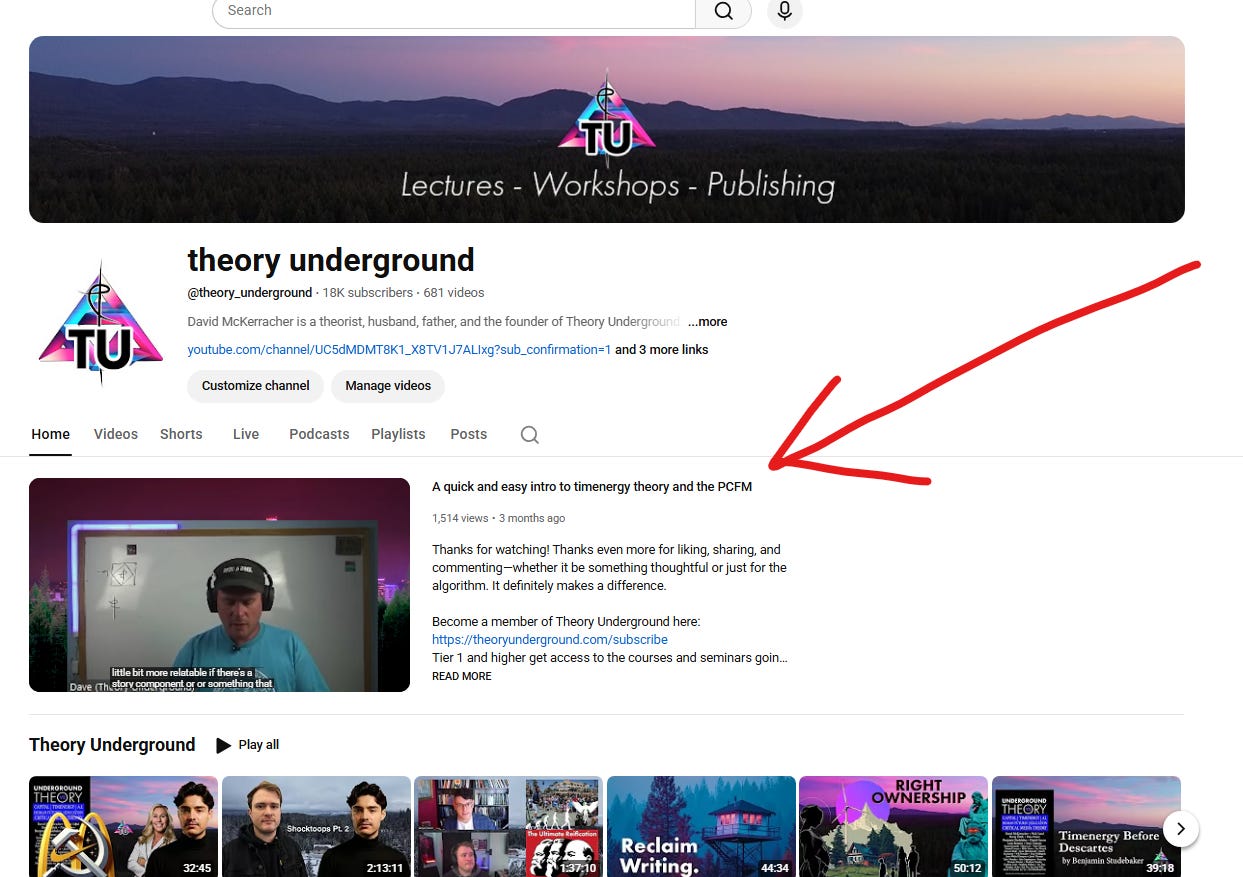
The problem is that not everybody sees this video. When I visit my own channel, this is what I see:
Or from mobile:
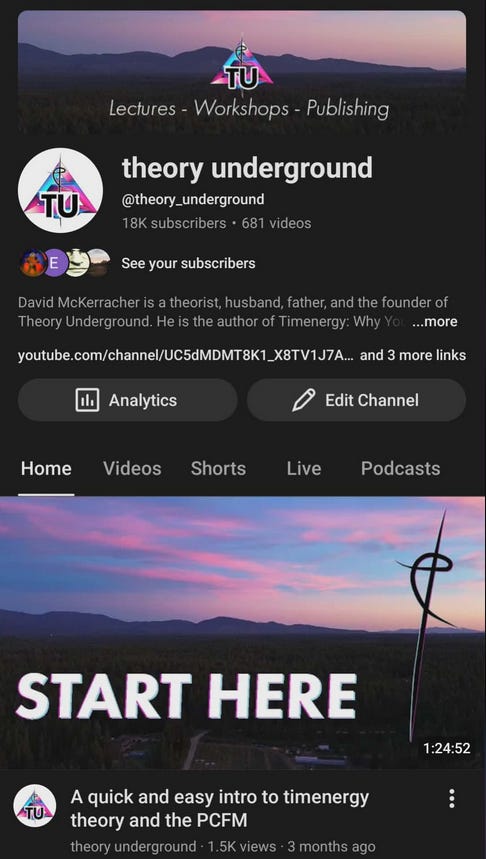
The problem is, you don’t always see that video when visiting Theory Underground. In fact, I have seen it from a ton of other people’s devices when they are checking it out for the first time and, for whatever reason, the recommended video simply doesn’t show up for them at all.
My big sister recently suggested that I make a playlist called Start Here or Getting Started at Theory Underground. I think she is right. I’ve been thinking about it a lot.
What would go on that playlist? I’m curious what you think. Please give me some feedback.
One thing is for sure, and that is that my appearance at The Becoming Human Project should be on there. Samuel Loncar asks amazing questions—and you get more of my origin story than anywhere else.
That plus the A quick and easy intro to timenergy theory and the PCFM should be plenty to get you started, but then, if you really want to dive into something deep, check out my essay from 2025, “Nature, Nurture, and Natality - David McKerracher’s N3 video essay”
My conversations with Tony of 1Dime are also really good entry-points and, on the internet, because of his reach, the avenue through which a lot of people first heard of my work. He has done several, each dedicated to essential threads such as timenergy, the Post-Class Fractured Mass, the professional managerial class .
But then again, I really love the lectures I’ve done with Ann… this one was where we first introduced people to the concept of the PCFM:
Then there’s the emerging theme that follows from that lecture on the canon vs the churn:
I would say though that there really is no proper starting point. With theory you are always going to be in over your head. Any introductory textbook is misleading. Theory is not math. My work is especially idiosyncratic, the people I associate with or invite on relate to my own lines of interest, but I do expect that a lot of it has almost universal relevance. It’s just that some people are more into the politically post-left or post-duopoly sides of the work whereas others prefer the stuff that relates to Lacan, Heidegger, or Bourdieu.
Personally, the best advice is just to click on whatever and listen to it while doing other things. It’s made for multitaskers who are likely to binge a lot and then re-listen to whatever calls their attention.
Learning is, after all, retroversive. Meaning comes about retroactively. Here’s a video from the Core Concepts series on retroversion. Embrace that idea and it will unlock everything.
In closing, here’s a provisional playlist that has all of the videos I’ve mentioned here. What videos would you add/remove? Have you found a better entry point?
For anyone who prefers podcast over YouTube: Whatever the starting playlist turns out to be, I will focus on making sure most of it is available on the podcast soon. I will, slowly but surely, get all of these added to the Theory Underground podcast—available on Spotify, Podcast Addict, Overcast, etc. After eight months of hiatus I’ve revamped it and am now adding more content every week.
Thanks for reading!
If you want to access the lecture courses and seminars, past and ongoing, at Theory Underground, become a member at https://theoryunderground.com/subscribe
Members get access to The Philosophy of Stewardship
Intro to Theory
and Philosophy of Religion
All three of those take place over the course of 2026 at Theory Underground—it’s not too late to join. Higher tiers get access to writing and speaking development workshops.
Members also get access to a catalog of past courses such as Intro to Political Theory with Benjamin Studebaker, The Philosophy of Nature with Nina Power, Intro to Marxism with Chris Cutrone, Intro to Lacan with Todd McGowan, Intro to Illich with Bryan Weeks, Intro to Zizek and Intro to Land with Michael Downs, and The Clinical Structures of Psychoanalysis with Leon Brenner—as well as all my past courses such as Martin Heidegger’s Being and Time, Levinas’ Totality and Infinity, The Idea of the University, Professional Managerial Class Consciousness and Ideology, and Critical Media Theory.
If that seems like too much, it’s true. Just focus on what you find most interesting—this is about your curiosity and the development of your thought itself, not an exam. You don’t have to do anything. There is no homework. You don’t have to catch up with anything but you get to binge whatever you want! https://theoryunderground.com/subscribe