

Tower of Babble
A reflection in the wake of Charlie Kirk: Free Speech vs. Shared Context

With BLOCKED BY AMAZON: On the Left’s response to Charlie Kirk coming July 4th, we are pre-releasing some of the chapters to build some hype. What follows is by David Ruiz,* a guest contributor.
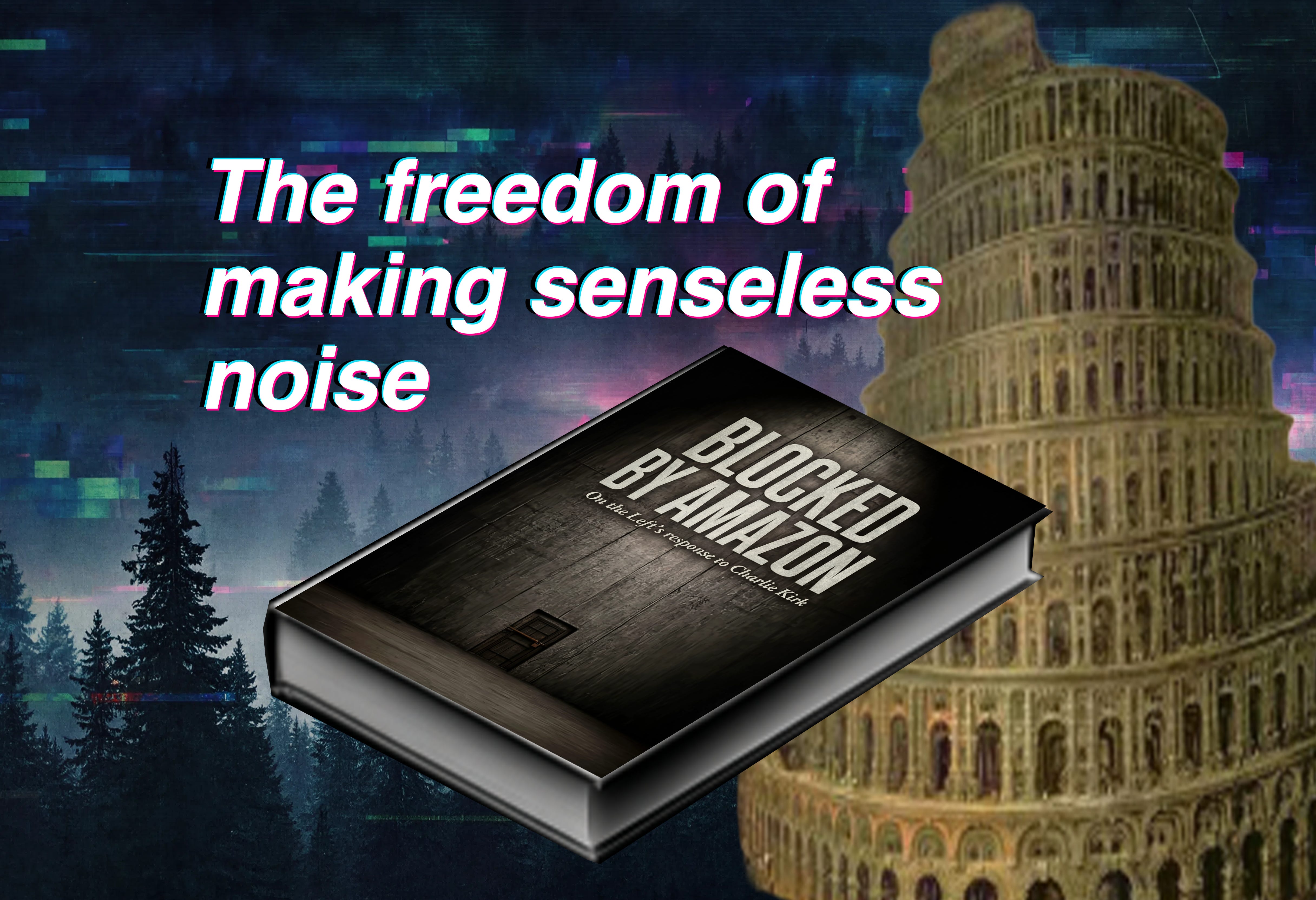
If you don’t already know about this volume or how it got blocked by Amazon, then you can check this out here: “Dissatisfying Customer Experience” as Amazon’s Definitional Reign of Terror | Conversation with Nick Land on the Amazon Block, and the Cathedral vs. Political Economy and the PMC — TRANSCRIPT
Tower of Babble
Now more than ever, after the brutal murder of Charlie Kirk, people have doubled down on the idea that we’re in the middle of a heated civil war over the freedom of speech. Yes, people are voicing more and more outrage over what they should and shouldn’t be allowed to say. Meanwhile, I’m growing more concerned that people may be fighting the wrong fight without realizing it. It seems to me like what people are really fighting for is the freedom to babble on incoherently. We watch all sorts of disconnected events happen throughout the day while never noticing that context has gone out the window. It’s obviously worse for those in the online world but even for the few Luddites who have managed to survive off of just TV, radio, and books, we’re living in a time of information glut. There’s no escape. It’s just a bunch of us reacting all day long and yelling about whatever pops into our worlds through screens of all shapes and sizes. There is absolutely no context to anything that we say or respond to. No one seems to notice or care either. A lot of people are spending their time not sharing ideas thoughtfully, but posting their tantrums to information presented in slot machine fashion instead. Are we contributing to a global conversation or are we all just stuck taking a never ending opinion poll? What is most important for me to know about next? [pull lever] How do you feel about this now? And how about this? How about now? And now?
In Amusing Ourselves to Death, Neil Postman, who’s also the first I heard use the term “information glut,” has a chapter titled “Now… This” In it he discusses how TV news presents us with these self-contained stories, one after another, that have nothing to do with each other at all. The only thing joining them together is an anchorman saying, “now… this” This way of presenting information does more to disorient someone than it does to inform them. This is only made worse by the fact that there’s a commercial interruption every 8 minutes or so. One moment you’re hearing about a possible railroad strike, then an earthquake in Haiti, and then about a looming recession that will most likely be the worst in history; followed by commercials selling us spray-on deodorant, golf clubs, and life insurance. Postman wrote this in 1985 when TV news was just starting to hit its stride. Fast forward to today, thanks to our smartphones and social media, we are living in the “Now… This” world 24/7/365. A thumb swipe has replaced the anchorman’s “now this…” and the TVs are in our pockets. You almost literally have to go into a remote part of the wilderness to avoid this nonstop stream of “information.” However, even there, you may still get a signal.
In 1985, as disorienting as it may have been then, at least there were only a limited number of sources, relatively speaking, of course. You had television, 5 years into the 24 hour news cycle experiment, along with radio, magazines, and newspapers. A lot of physical media. Today our smartphones, which are themselves a piece of physical media, are more like portals. They allow us to enter into a cyber womb of our very own algorithmically powered thought bubbles and echo chambers. We’re already living in our very own virtual worlds where bots and worms of all sorts nibble away at our brain stems and regurgitate back to us not only all the things we love, but more often, for engagement purposes, all the things we love to hate. The more time we spend online, the more we seem to become uncomfortable and unable to handle the conflicting information presented to us by the real world. I should be allowed to live my life and listen to only what I want to listen to and nothing else. I should also be allowed to say anything I want to, whenever I want, to whoever I want. So I could see where the urge to fight for the freedom of speech comes from but what about taking the responsibility to know what we’re talking about? What about context? What about not being an asshole? We like to point the finger at everyone else about “alternative facts” but it seems like we’re all collecting random facts and ideas from an assortment of sources which only niche groups of people share. Whether they are true or not doesn’t seem to matter as much today as whether or not they provide us with the arsenal we use to bombard everyone and no one at the same time with.
This sounds a lot like what Neil Postman calls the great loop of impotence. He says, “Voting, we might even say, is the next to last refuge of the politically impotent. The last refuge is, of course, giving your opinion to a pollster, who will get a version of it through a desiccated question, and then will submerge it in a Niagara of similar opinions, and convert them into—what else?—another piece of news. Thus, we have here a great loop of impotence: The news elicits from you a variety of opinions about which you can do nothing except to offer them as more news, about which you can do nothing.” The internet and social media have automated the jobs of pollsters and the news in this process. It has made the process transparent. People used to avoid pollsters but now people can’t seem to get enough of posting their unsolicited opinions/emotional outbursts online voluntarily.
This approach to “conversation” and “debate,” which drives people to gather this assortment of disconnected information, seems to make us susceptible to straw-man arguments, oversimplifications and other tribal tendencies. Sometimes it feels to me like 90% of all the content on the internet (besides porn obviously which probably makes up most of the internet) is either outrageous claims about how something random is racist and then other people being outraged by those people saying that something is racist. For example, “people didn’t support ______ because they’re racist.” This goes alongside content that says “can you believe people said that people didn’t support ______ because they’re racist?” We don’t seem to engage in any arguments here but instead resort to “gotcha” statements or pointing the finger at people we think are ridiculous (this might be an example of “owning the libs” style content of which Charlie Kirk was known for pioneering online. Rush Limbaugh passed him the torch. Stephen Colbert could be the left’s version). We scour the internet for these pieces of information that trigger us. Some people need trigger warnings while others soak in a bath of as many triggering pieces of content as they can get their hands on. C. Thi Nguyen refers to this content as moral outrage porn in a paper by the same name. He says that we’re in danger of becoming habituated to using information not to inform ourselves but simply to sift through it for material we can use in our moral outrage posts. We collect information not to educate ourselves in order to make important decisions but to use the bits collected as “I told you so’s” and weaponized scoffs used to attack strangers (and more and more, bots).
Freedom of speech is definitely important, but I also think that right now it isn’t as urgent as fighting for context. It’s not far-fetched to say that this chaotic, cacophonous media environment played a significant role in Charlie Kirk’s assassination. I would say that this environment contributed not only to why some appeared to dehumanize Charlie but also to why Charlie himself appeared to dehumanize others. Regardless of either side’s intentions, the truth gets lost. When we all succumb to these chopped up, incendiary versions of reality created to snatch away our attention by any means, we can’t be surprised when we can no longer understand each other. What’s the point of fighting for the freedom to talk past each other all the time? What is that going to help us accomplish? Wouldn’t those in power take advantage of this situation? Also, and maybe even more terrifying, doesn’t it seem like those in power are caught in the same trap? One of the advantages of the internet has been to topple the gatekeepers but one of its consequences has been the abandonment of the water cooler. It’s great to avoid those people who we hated to see or hear from but we’re also missing opportunities to find where we share similar struggles. We might be able to help each other in some way if we can figure out how to start communicating. This isn’t going to be easy and the George Carlin in me says it’s highly unlikely to happen but we should give it a shot anyways. At this point, fixing America is like trying to get a casino full of paranoid schizophrenics to sit down together and start a friendly game of Monopoly.
As much as I wanted to end this piece with that clever little line on Monopoly for schizophrenics, I’d rather have Neil Postman have the last word with one of my favorite quotes.
“Nonetheless, everyone had an opinion about this event, for in America everyone is entitled to an opinion, and it is certainly useful to have a few when a pollster shows up. But these are opinions of a quite different order from eighteenth- or nineteenth-century opinions. It is probably more accurate to call them emotions rather than opinions, which would account for the fact that they change from week to week, as the pollsters tell us. What is happening here is that television is altering the meaning of “being informed” by creating a species of information that might properly be called disinformation. I am using this word almost in the precise sense in which it is used by spies in the CIA or KGB. Disinformation does not mean false information. It means misleading information—misplaced, irrelevant, fragmented or superficial information—information that creates the illusion of knowing something but which in fact leads one away from knowing. In saying this, I do not mean to imply that television news deliberately aims to deprive Americans of a coherent, contextual understanding of their world. I mean to say that when news is packaged as entertainment, that is the inevitable result. And in saying that the television news show entertains but does not inform, I am saying something far more serious than that we are being deprived of authentic information. I am saying we are losing our sense of what it means to be well informed. Ignorance is always correctable. But what shall we do if we take ignorance to be knowledge?
Thanks for reading.
Author Bio:
*David Ruiz (B.A in Philosophy and Psychology) is an independent scholar and fellow traveler at Theory Underground and the Maurin Academy. He has a research project centered around the work of Neil Postman. He came to love philosophy after admiring the work of George Carlin, Bill Hicks and Doug Stanhope. He grew up playing Football, loves making music with samplers and synthesizers and doesn’t want you to know that he plays Magic the Gathering. He also has no idea why, and feels weird about the fact that, he wrote his own biography in the third person.