

Relationships Aren't Colonized Enough, Actually
Why Polyamory is Impossible: Timenergy and The Virtuous Circle

Polyamory has been on the rise, from a fringe lifestyle to a progressive virtue flex. It became impossible to ignore when Will Smith slapped comedian Chris Rock. We could all see there was something clearly wrong in that man’s eyes and heart. Soon after the rest of us, those who don’t follow this kind of thing, heard the rumor that his wife had gotten Will to “open up” the relationship.
I call it a rumor because she apparently later denied that this was the case. Regardless, when Will’s daughter Willow had, prior to this incident, come out as polyamorous while on a talk show with her mother, Jada Pinkett Smith, Willow called monogamy “antiquated” without any pushback from Jada.1 Whatever we can say about Will Smith, one thing is certain: he is surrounded by women who do not have the highest estimation of lifelong committed monogamy. I don’t really care what they as individuals think, nor do I aim to change anyone who is poly’s mind. The issue is that such people are rarely just doing it. I’s not a “you do you” and “mind your own business” kind of thing because they’re on a mission to normalize it while attacking monogamy.
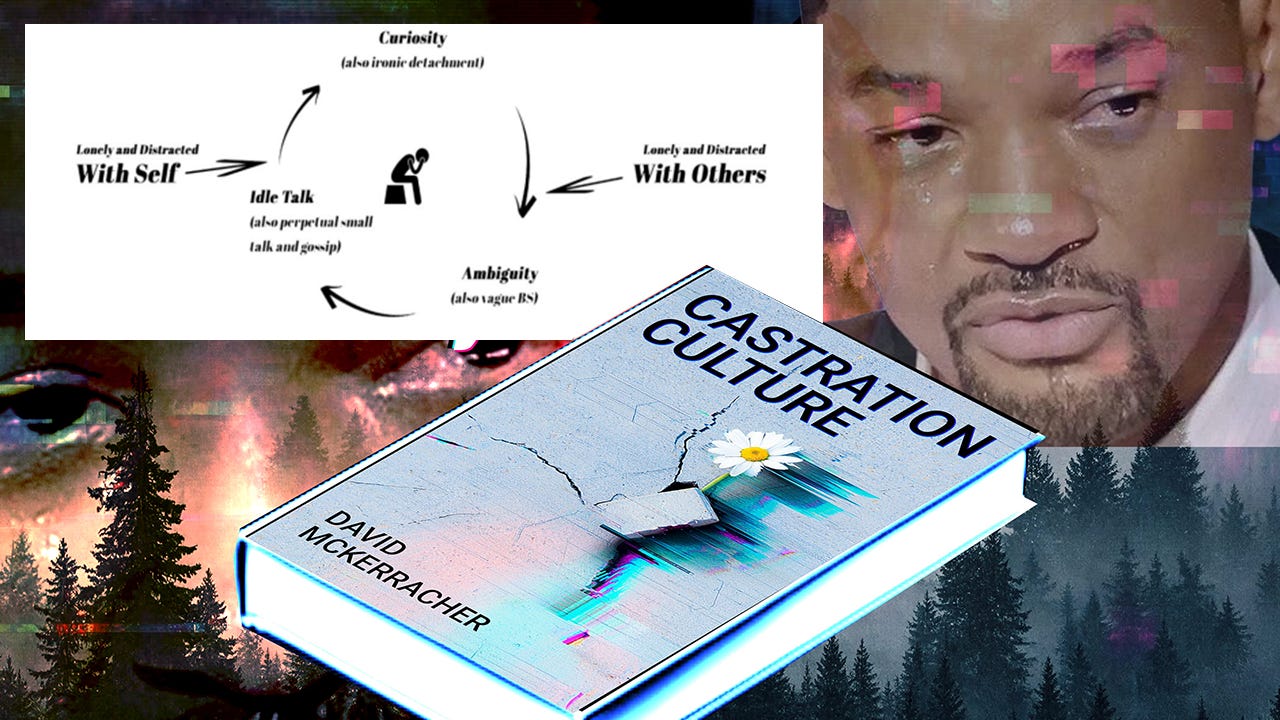
What this chapter’s installments will show is, in part, that polyamory is impossible — impossible to scale, across populations and generations, without leading to catastrophe (it fails what I call the “pro-civ test,” something developed at length in my forthcoming work). Along the way we will learn why monogamy, as it is practiced in the culture of the liberal rumspringa, is itself also not tenable.2 It’s not just a matter of survival, but of flourishing. The most important question we will ask: what kind of human subject does this kind of culture cultivate?
A Quick Definition
At this point I suspect most of my readers know what “polyamory” means, even though it’s a recently invented word. But for anyone lucky enough to have missed this in the last fifteen years: polyamory is a mashup of Greek and Latin words that translates to “many loves.” Monogamy generally means a committed relationship between two, whereas poly people “open it up” and “bring others in” for what they now call “consensual non-monogamy.” Generally, monogamy was seen as progress beyond the actual historical norm in the most patriarchal societies, i.e. polygamy.
When explaining all of this to someone the other day, she said, “So polyamory is like the libcucked version of polygamy?” By which she meant, playfully of course, that poly is an uber-progressive inversion of polygamy where the man, rather than possessing many wives, instead gets cucked by many girlfriends. Will Smith became the face of that kind of male, but he is far from being alone.
Poly, So Hot Right Now
Molly Roden Winter’s More: A Memoir of Open Marriage hit the New York Times bestseller list and drew coverage in the Times and New York magazine.3 Around that time Peacock aired a reality show about “throuples” (intimate unions of three) called From Couple to Throuple. A 2023 Pew study found that a slim majority of adults under thirty now say open marriages are acceptable. And of course there are other celebrities “coming out” as poly, such as the actor Nico Tortorella who has been poly for years.
Celebrities do all kinds of weird things though so they’re not necessarily canaries in the coal mine on this issue. The hardest fact to wave off is the legal one: in 2020 the city of Somerville, Massachusetts voted unanimously to remove the two-person limit from its definition of “domestic partnership,” becoming the first city in the country to recognize relationships of more than two people.
Cambridge, Arlington, Oakland, and Berkeley soon followed, working from a model ordinance drafted with a clinic at Harvard Law School.4 Five years on, Somerville had twenty-two multi-partner domestic partnerships registered and one of its two candidates for mayor was an openly polyamorous city councilor.5 This may be a subculture, but it has bestsellers, reality shows, and city ordinances behind it now.
Why It Matters
If you think this is not a very philosophical matter, that these are just horny college kids and weirdo celebs rationalizing their sex lives, then you wouldn’t be the first. However, I think that the rise of polyamory over the last fifteen years has a lot of causes and that it is more than a limit case or mere symptom of other issues.
Poly has an ideological rationale which, if you have enough of the secular progressive priors in place, will actually sound seductive and enlightened. The normal way people respond to polyamory is to say “I just couldn’t, I’m too jealous,” almost like it’s a personal failing. As though, if you were more overflowing with love and virtue, you would open it up. This is a terrible framing that sets people up for failure.
I’m not writing this as an outsider, but as someone who has always challenged every orthodoxy, who has been doing a ruthless critique of all common sense ideologies for over twenty years. I spent a good amount of time being anti-monogamy. Like most of the norms that I challenged though, from holidays to marriage, I have realized that it was I who was the idiot and the traditions were, in fact, good for reasons that go far beyond their normal justifications. So for over a decade now I’ve been theorizing exactly why polyamory fails, and what it teaches us about the deep wisdom of certain norms. For those who are new to this topic, I’m here to save you some time and supply you with better arguments for monogamy, and against both polyamory and polygamy.
To really get into this will take some time. I wrote this as a chapter of my book Castration Culture provocatively titled “Relationships Aren’t Colonized Enough, Actually.” This is part one, where I’m going to get the most theoretical. Over the course of this series I aim to show that polyamory is not just the wokest of the woke ways of performing how you’re so woke you don’t get jealous. Rather, poly is the fulfilment of Big Romance when it combines with certain ideas native to the rebel priest class who administers the liberal rumspringa in capital’s culture of castration — all terms developed in other parts of the Castration Culture series. You can read this as a stand alone piece or go read my posts The Natality Pill and Castration Culture pt. 1.
The Most Radical of the Radicals
There is an Instagram account called Decolonizing Love. It has a modest following and an immodest thesis: non-queer closed relationships are oppressive products of colonialism and its hierarchies. In a recent post, they claimed that “hierarchy” was “a linguistic ghost before the 16th century” and that “its explosion into the modern psyche was a deliberate act of intellectual alchemy, largely via Louis Dumont, that reframed raw domination as natural order.” The post concludes that, “What you defend as ‘common sense’ is colonial ideology wearing its latest mask.” They close by warning readers to “do the homework before you step into the ring.”
The Decolonizing Love account is run by a polyamorous couple in Toronto. Millie is a relationship anarchist and activist. Nick identifies as non-hierarchical polyamorous. They sell coaching sessions, run workshops, and promote a Relationship Agreement Generator through their website.
The Decolonizing Love project argues that hierarchical relationships are inherently unethical, that monogamy is a product of colonialism and patriarchy, and that jealousy is a conditioned response to be unpacked through therapeutic processing. So basically 99.9% of all relationships that have ever existed in any large-scale civilization throughout time were bad.
The thing about Millie and Nick is that they did not pop into existence from nowhere. They are the tip of a body of literature that has been growing since the sexual revolution, especially in purportedly radical or alternative spaces.
The Poly Canon
Behind Decolonizing Love sits a canon: The Ethical Slut by Dossie Easton and Janet Hardy (1997), More Than Two by Franklin Veaux and Eve Rickert (2014), Polysecure by Jessica Fern (2020), Opening Up by Tristan Taormino (2008), Stepping Off the Relationship Escalator by Amy Gahran (2017), and Sex at Dawn by Christopher Ryan and Cacilda Jethá (2010).
These six books, plus a growing infrastructure of workbooks, journals, podcasts, coaching certifications, and Instagram and TikTok accounts, constitute the intellectual foundation of contemporary polyamory. They share a set of philosophical commitments that have never been seriously examined. This chapter examines them while demolishing some of their core premises.
The poly way is a new anti-civilizational orthodoxy that promises itself capable of replacing the structures that make love, family, and human flourishing possible. The simple progressive approach will call monogamy antiquated, whereas the most “radical” of the radical leftists will call it “colonial false consciousness.”
I will show that both are wrong, and that their proposed alternative lifestyle is structurally impossible to scale across the population and across generations. To do that requires some theoretical heavylifting, to which I will now turn.
I. The Virtuous Circle and Why It Breaks
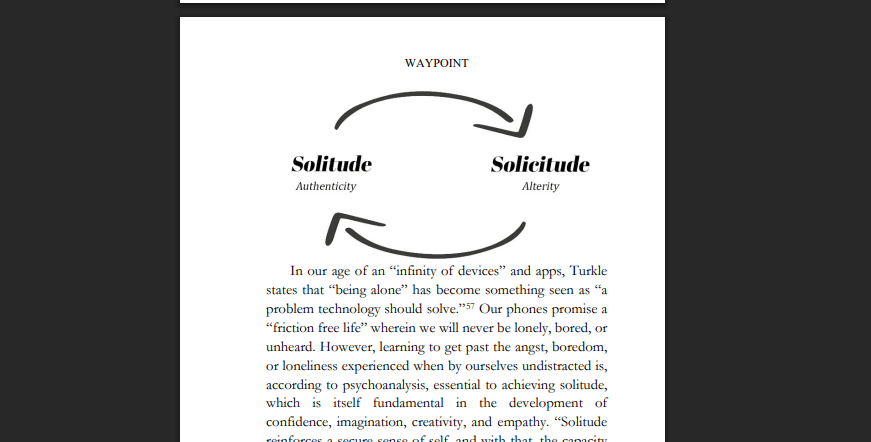
The sociologist and clinical psychologist Sherry Turkle studied under Lacan in Paris before writing a series of bestsellers about technology and human connection. In Reclaiming Conversation (2015), Turkle identifies what she calls the virtuous circle: the healthy, reciprocally dependent interplay between solitude and solicitude. Solitude here means genuine being-with-oneself. Solicitude means genuine being-with-others.6
The circle works like this: being alone, undistracted, leads to imagination and reflection. That leads to creativity and empathy. That leads to a secure sense of self and confidence, not the fake confidence of pickup artists and LinkedIn gurus, but the real thing: you have found your talents, you have cultivated them, and you know you have something to offer the other. That secure sense of self leads to deep connection and a more fulfilling social life. That solicitude, the genuine being-with-others, then feeds back into solitude: it gives you something to reflect on, something to work with, raw material for the imagination. The two poles sustain each other. Neither works without the other.
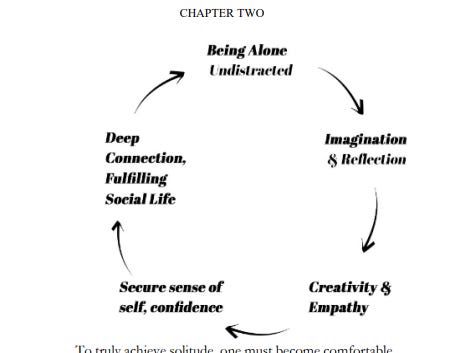
If you don’t feel confident, you haven’t succeeded in solitude yet. If you don’t feel confident, you haven’t found your talents yet. And if you have found your talents but still don’t feel confident, you haven’t gotten the opportunity to truly cultivate them. That is a structural problem, not a personal one. As unpacked in chapter three of my first book, Waypoint, the structural stultification of timenergy results in the collapse of the virtuous circle.
When a society prioritizes production and development ahead of all else, the communally available large and reliably repeatable blocks of time-with-energy that are the default for people, which I have theorized as “timenergy,” gets reduced to “labor power.” Labor power is either a commodity competing in the “free market” or it is centrally managed by bureaucrats, but regardless of whether it is socialistic or capitalistic, the point is that modern people don’t really have timenergy because our whole lives are spent making ourselves as exchangeable as possible in the service of production.
What happens when the circle breaks? The two poles become refractory. Instead of pulling you in, they push you away. You can’t achieve genuine solitude because you’re always distracted, always on call, always reaching for a device that promises friction-free escape from the anxiety of being alone with yourself. And you can’t achieve genuine solicitude because you haven’t developed the secure sense of self that would let you show up fully for another person.
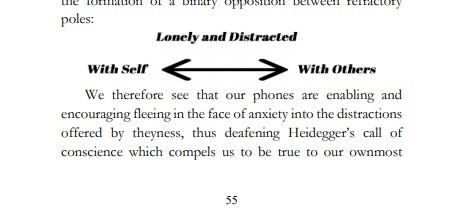
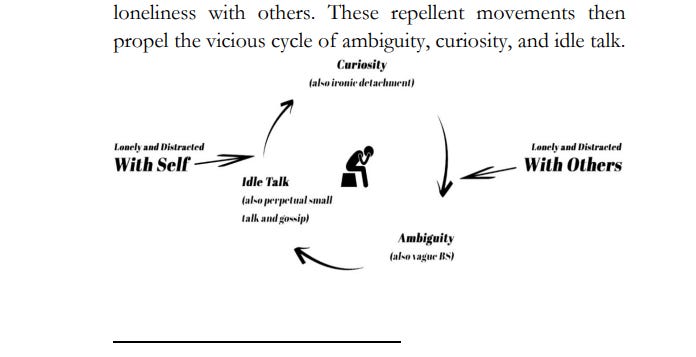
You end up lonely and distracted with yourself, and lonely and distracted with others. In between the refractory poles of the collapsed virtuous circle you spin in what I call the vicious cycle. It’s a phenomenon first seen by Kierkegaard, which got its formal and structural development by Heidegger. For the ease of teaching the vicious cycle, I like to name its three moments as the ABCs of falling: A for ambiguity (never getting to the bottom of anything), B for blah blah blah (idle chatter, the superficial exchange of whatever is trending), and C for non-committal curiosity (flitting from thing to thing, never committing). These three feed each other and result in most people settling for a presentist naive and hyper-distracted mode that Heidegger called “falling.” We don’t need his fundamental ontology to get into it though, the point is that when caught up in ambiguous and non-comitally curious idle chatter, you stay at the surface, leaving your talent to rot. The self achieves no heights or depth — the vertical itself becomes indistinguishable from oppression and one turns their one-dimensional plane of existence, forced by necessity, into a virtue.7
I wrote my second book, Timenergy: Why You Have No Time or Energy, largely at an Amazon warehouse during lunch breaks and bathroom breaks — after a lifetime of never having the timenergy to write a proper book, I chose to do it with my fragmented bursts of energy and time. What was it I was theorizing, though? In short: the concept of timenergy signifies something everybody already knows but nobody has a technical term for: large, reliably repeatable blocks of time-with-energy.8 Not time-without energy or energy-without-repeatable large blocks of time. What matters is the combination, time-with-energy regularized into repeatable blocks substantial enough to sustain the virtuous circle. [Without going into the ontological and ontic structures that underpin this, because we don’t have time, I hope the definition alone will suffice.] Modern job-centric societies are designed to make timenergy almost impossible. You might have time after work, but you’re drained. You might have energy on the weekend, but it’s consumed by recovery and errands. Timenergy is a necessary condition for the Good Life, but we don’t have any because of our work-centric society. That’s the thesis.3
What’s the problem with polyamory, and the deep wisdom of monogamy? Keeping the concepts of timenergy and the virtuous circle in mind, let’s turn back to the poly canon. Its founding axiom is that love is abundant. The Ethical Slut, the 1997 book that launched the movement, argues that we live in a “starvation economy” that conditions us to treat intimacy and love as scarce resources, producing jealousy, possessiveness, and fear. Reject the scarcity model, the authors promise, and love will flow like air.
Love may not be finite, but timenergy for achieving the virtuous circle is certainly scarce. The solitude and solicitude required for one single deep loving intimate relationship already tax the limits of a human life. You need solitude with your partner and solitude without your partner. You also need solicitude with your partner and solicitude without your partner. Right there are four distinct modes of being, each requiring substantial blocks of time-with-energy, and they compete with each other constantly.
Anyone who has ever tried to sustain a deep relationship while maintaining a friendship network, a creative practice, a spiritual life, and a sense of self knows that the balance is already precarious with one partner. Multiply the partners and the virtuous circle doesn’t just become harder. It becomes impossible. The refractory effect kicks in: both poles push you away.
What fills the gap is the ABC circuit of the vicious cycle: ambiguous processing that never resolves, blah blah blahing about feelings that never come close to genuine discourse, and non-committal curiosity about one’s own emotional states that flit from partner to partner, from NRE (new relationship energy) to NRE, never achieving the attunement that only comes from staying.
Max Scheler’s ordo amoris, his concept of the objective order of love, reveals the deeper error. The poly canon treats all love as quantitatively the same: more or less of a single substance to be distributed across more or fewer recipients. Scheler says the opposite: love is qualitatively ordered.
Different kinds of love exist for different kinds of relationship, each with its own proper form. Loving your spouse differently than you love a casual partner is not a hierarchy problem. It is the correct operation of the heart. The failure to rank, the failure to love things in their proper order, is what Scheler identifies as the fundamental moral disorder.9
In what follows I’ll take Scheler’s initial work a step further, to show the absolutely necessary hierarchy of attention goes all the way down to perception itself — the choice is never of whether to privilege one over another, but rather, who to prioritize. Not choosing is also choosing, it’s just not romantic.
Worse, poly does not scale across populations or over time in a way that stands a chance to be pro-civ. There’s a reason that poly people, when looking for precedent in previous societies, cannot find examples beyond monkeys or small groups of people incapable of reading or defending themselves. With timenergy and the virtuous circle now on the table, the reader will have enough to know why. But there’s a lot more to the argument, for which you’ll need to stay tuned.
This was part one of the chapter “Relationships Aren’t Colonized Enough, Actually.” So far I have only shown why the founding axiom of the poly canon, that “love is abundant,” breaks the moment you account for timenergy and the ordered structure of the heart. Next I will show that poly is not the cure for monogamy's failures but their completion. If you want to follow the argument to its own completion, make sure to subscribe.
If you want to back the Castration Culture book directly, you can pledge on the website, which is coming soon.
Thanks for reading.
Red Table Talk, "Is Polyamory For You?," directed by Adrian M. Pruett, aired April 28, 2021, on Facebook Watch, https://www.facebook.com/redtabletalk/videos/is-polyamory-for-you/904644817023031/. Or the short clip on YouTube:
David McKerracher, "The Natality Pill: Post-Vasectomy Baby Fever," Theory Underground (Substack newsletter), March 25, 2026, https://theoryunderground.substack.com/p/the-natality-pill
LONG QUOTE from that chapter:
“Rumspringa is the Amish practice of allowing adolescents, typically around sixteen, to leave the community temporarily and experience the outside world before deciding whether to commit to the Amish way of life and be baptized.5 It is a supervised, culturally scaffolded window of exploration, and crucially, it has an endpoint. You go out, party a lot, and then you decide whether to come back and commit.
The corporate liberal urban monoculture offers its own sort of rumspringa, but there are some crucial differences.6 The Liberal Rumspringa goes hand-in-hand with Castration Culture, meaning that it is a culture that cannot replace itself. Instead, it recruits youth from other cultures—selling itself as freedom and progress against the confines of tradition or commitment.
Unlike the Amish Rumspringa, the Liberal Rumspringa lacks the scaffolding, expectation of return, or any positive vision of what you’re supposed to come back to. Instead, it is quite the opposite: you are expected to never go back except as a dark apostle of capital—instead of converting souls for a heavenly kingdom, you are to convict faith in institutions.
As someone who spent nearly twenty years on a Liberal Rumspringa, I cannot talk about this culture as though it is an Other. I still belong to it, at least in the sense that it still has its claws in me. With that said, I have been using its most powerful weapons against itself. Let’s call it an immanent critique, i.e. sympathetic, charitable, and from inside-out, always with the hope of preserving the essential goods that it monopolizes.”
The Natality Pill

I know two guys in their twenties who, in the last five months, each got a vasectomy. This has had me thinking. As a guy who almost got one as well, multiple times, but instead is now becoming a father in his late thirties, I have a lot of feelings about this. So, suffice it to say that what follows is going to be both intimate and theoretical.
Molly Roden Winter, More: A Memoir of Open Marriage (New York: Doubleday, 2024).
On Cambridge, Arlington, Oakland, Berkeley, and the Polyamory Legal Advocacy Coalition / Harvard Law clinic role: “Love and the Law: A Look at Polyamorous Camberville,” Harvard Crimson, October 18, 2025, https://www.thecrimson.com/article/2025/10/18/polyamorous-somerville/.
On the twenty-two registered partnerships and the polyamorous mayoral candidate (Willie Burnley Jr.): “Polyamory in Somerville 5 Years After Legal Recognition,” American Spectator, November 1, 2025, https://spectator.org/polyamory-in-somerville-5-years-after-legal-recognition-22-official-throuples-and-a-poly-mayoral-candidate/.
Sherry Turkle, Reclaiming Conversation: The Power of Talk in a Digital Age (New York: Penguin, 2015). The virtuous circle concept draws on psychoanalysis (Turkle studied under Lacan in Paris) and on the phenomenological tradition, particularly the reciprocal dependence of authenticity and alterity in Heidegger and Levinas respectively. My own use of Turkle’s framework, developed across the critical media theory course at Theory Underground and in Chapter 2 of Waypoint: Timenergy, Critical Media Theory, and Social Change, emphasizes the structural conditions (timenergy, the mode of production, the relations of production) that make the circle possible or impossible. Turkle’s analysis is media theory. Mine is critical media theory: the difference is Marx. Also, btw, “solicitude” is my term — Turkle doesn’t use it in Reclaiming Conversation, but it is the better word for the pole that is structurally in productive tension with solitude, so that’s how I talk about it.
The vicious cycle (Ambiguity, Blah blah blah, non-Committal curiosity) draws on Heidegger’s analysis of “falling” in Being and Time, particularly the three-fold structure of ambiguity, curiosity, and idle talk (Gerede). See Martin Heidegger, Being and Time, trans. John Macquarrie and Edward Robinson (New York: Harper & Row, 1962), Division I, §§35-38. Kierkegaard’s analysis of “the public” in The Present Age (1846) anticipates the same structure. The terms ABC and the language of “refractory poles” are my own from my piece called Virtual Enframing in my first book Waypoint: Timenergy, Critical Media Theory, and Culture War.
David McKerracher, Timenergy: Why You Have No Time or Energy, foreword by Slavoj Žižek (Theory Underground Publishing, 2023).
Max Scheler, "Ordo Amoris," in Selected Philosophical Essays, trans. David R. Lachterman (Evanston, IL: Northwestern University Press, 1973).
There's an important dialectic at play in a monogamous loving relationship (which gets disrupted even by introducing a baby!) - when I take my heart out, worry about someone more than myself: but like truly care in a preconceptual way, that they're having fun, ate well, etc... it's impossibile for me to focus on myself. If I can I haven't really given myself up to this deep level of care. In a situation like that I would become bankrupt, but the unique contradiction is my partner gives it back. And I get cared for better than I would've cared for myself by caring for someone more than I would care for myself. This reciprocity is hard to create in open network situations. I've tried. And I'm not talking about codependency - platonic other halves. It's antinomy.